The framework of relational intelligence
WHAT IT IS
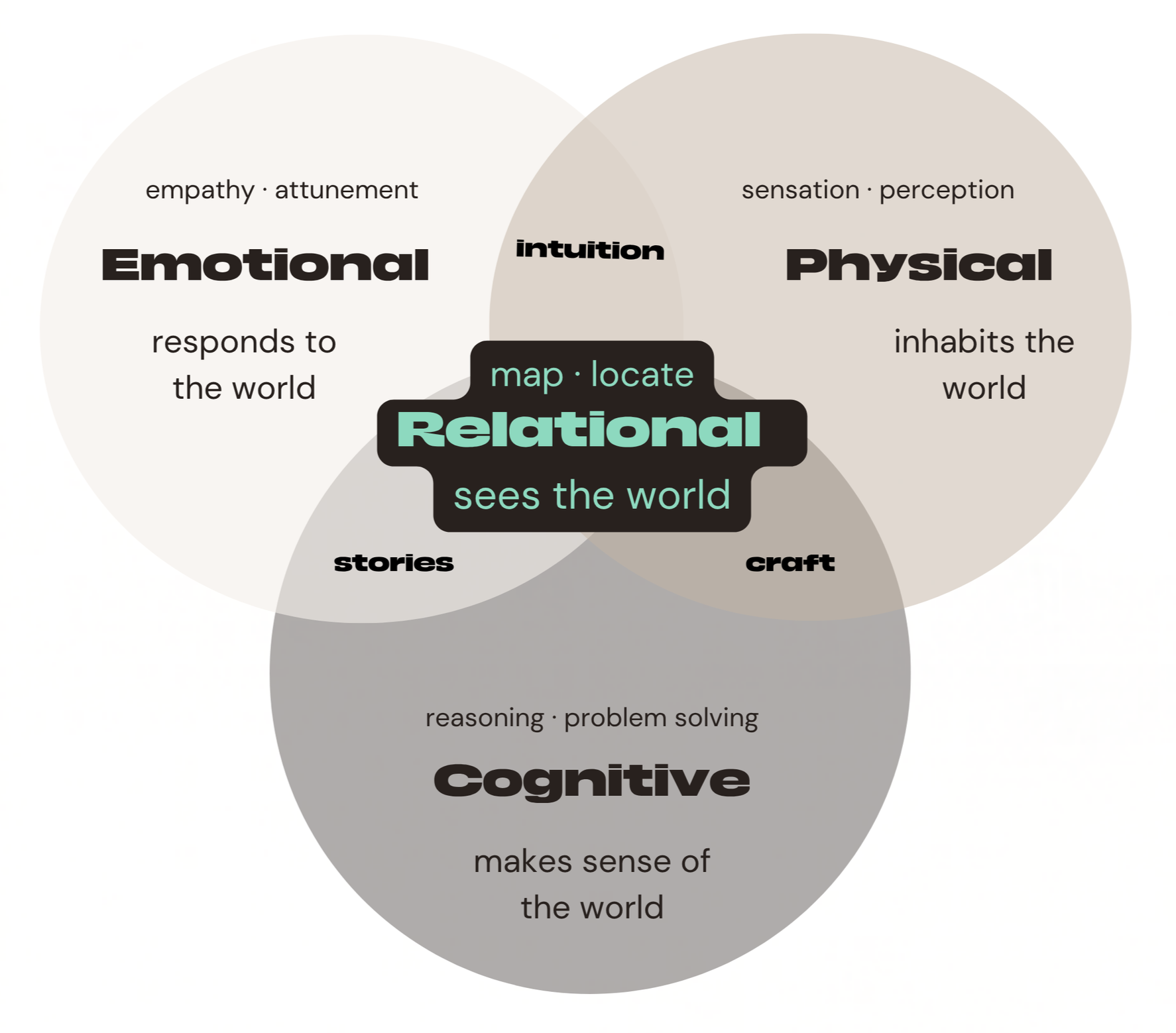
I call the theoretical framework underpinning my methodologies relational intelligence. Relational Intelligence (RI) is the capacity to map, understand, and act on our connections to the world around us — the people, systems, and environments included. At its core, it is a structural capacity: the ability to read relational networks, locate yourself within them, and respond in ways that move things forward.
Building emotional, cognitive, and physical intelligence improves our ability to feel, think, and do. Building relational intelligence brings them all together to see the world where we’re operating, which is especially important for organizations to nurture and hold.
-

IN PRACTICE
RI is not the methodology. RI is what the methodology develops by filling in those gaps. That means bringing in and synthesizing qualitative data from the people connected to the problem space. The methods I use work best when combined with quantitative data to validate understanding and with action-oriented planning that uses the realities surfaced during interviews.
-

RIGHT NOW
Most organizations are operating almost entirely from cognitive capacity: data, metrics, analysis. The relational layer is there, but it's invisible. As AI absorbs cognitive tasks, RI becomes the irreplaceable human capacity. And as AI systems gain greater access to the physical world and human bodies, the imperative to build on a strong relational, and therefore ethical, foundation will only become more urgent.

WHERE IT CAME FROM
RI didn't come from one place. It came from everywhere I've been taught to pay attention.
UCSD's Cognitive Science department taught me how to think about thinking, and Dr. David Kirsh and Dr. Jim Hollan trained me in human-centered design— the foundation everything else is built on.
IDEO and IDEO.org gave me the rare opportunity to apply that methodology alongside the best practitioners in the world.
The National Equity Project's Liberatory Design framework updated my understanding of HCD, particularly by highlighting how it had left out equity.
The scholarship of Linda Tuhiwai Smith, Corey S. Shdaimah, Roland W. Stahl, and Sanford F. Schram expanded my understanding of what a research methodology is, why every method needs a theory to underpin it, and how to ensure research leads to action.
And my teacher, Marza Millar, who explained to me the ancient art of feel-think-do, gave me the simplest and most durable frame for what RI actually does.
AN OPEN INVITATION
Relational Intelligence is intentionally unenclosed. The phrase is used in many fields. This application is meant to function as a common language: available to anyone who finds it useful, not owned by any one person or business.